

What Nvidia’s Earnings Could Tell Us About the AI Boom—and Your Retirement Portfolio

Wednesday’s Nvidia earnings will put the AI boom back in the spotlight. For retirement investors, the bigger question is how much of their portfolio’s success has become tied to the same theme.
How much of your portfolio’s success is becoming dependent on artificial intelligence?
That is a more useful question for retirement investors than trying to predict whether Nvidia will beat Wall Street’s expectations Wednesday afternoon.
Nvidia has become one of the clearest gauges of the enormous investment taking place in artificial intelligence. The company reported $81.6 billion of revenue last quarter, up 85% from a year earlier, and projected approximately $91 billion for the quarter it will report this week. Nvidia is scheduled to release those results Wednesday, August 26.
For retirees and those approaching retirement, Nvidia provides a timely reason to look beneath the surface of a portfolio. AI may offer significant long-term opportunities. It can also create concentration that is easy to overlook.
1. Nvidia Has Become Bigger Than an Earnings Story
Nvidia increasingly serves as a window into the broader AI investment cycle. Strong demand for its processors can indicate that major technology companies are continuing to build computing capacity and invest heavily in artificial intelligence. Its results can also provide clues about whether that extraordinary spending is beginning to produce the economic returns investors expect.
That matters because the conversation around AI is changing. The question is no longer simply whether artificial intelligence will transform the economy. Investors are beginning to focus more closely on which companies will benefit and how quickly those benefits may appear. Rising borrowing costs have added another consideration because the infrastructure behind AI requires enormous amounts of capital. Reuters recently described Nvidia’s earnings as an important test of the durability of the AI-driven market rally.
Wednesday will give investors another useful data point. It will not provide a verdict on the future of artificial intelligence.
2. Your AI Exposure May Be Larger Than You Think
Many investors think of AI exposure as owning Nvidia or a technology fund. The theme has become much broader. AI investment now reaches semiconductor companies, cloud-computing businesses and the infrastructure required to support data centers.
That creates an interesting diversification challenge. Reuters recently noted that AI-linked businesses have become increasingly influential across stocks, bonds and private markets. An investor may therefore own several different investments that appear diversified while many of them remain sensitive to the same underlying AI investment cycle.
This does not make AI a bad investment theme. It means investors should understand what is actually driving their portfolio. Owning many securities is not necessarily the same as having many independent sources of return.
3. Your Retirement Plan Should Not Depend on One Prediction
There will be no shortage of predictions before Nvidia reports. Strong results will be viewed by some as confirmation that the AI boom has much further to run. Others will focus on valuations and whether the enormous capital commitments being made today can eventually produce sufficient returns.
Retirement planning has a different job. Your ability to pay next year’s expenses should not depend on correctly forecasting Nvidia’s earnings, the next Federal Reserve decision or the timing of a market correction. Those events can affect markets, but they should not control the success of a well-designed retirement strategy.
That distinction becomes particularly important when a powerful investment theme has already produced substantial gains. Long-term investors may want exposure to future growth. Retirees also need enough financial flexibility to avoid selling those growth assets simply because the market has chosen a bad month to cooperate.
Give Every Dollar a Job
This is where the Boutique Family Office™ approach differs from an investment-only conversation. We do not begin by asking whether Nvidia should go up or down after earnings. We begin with the family’s goals and determine what each portion of their wealth needs to accomplish.
Our Strategic Wealth Alpha GPS™ retirement planning process organizes assets around four different jobs. Income Now and Income Later are designed around current and future spending needs. Growth can pursue longer-term opportunities, including transformational themes such as artificial intelligence. Legacy addresses wealth intended for family and other long-range goals.
That structure matters because money with different purposes should not automatically carry the same risks. If near-term spending is appropriately planned, growth assets have more time to recover from normal market volatility. The investor is also less likely to make a long-term decision because of a short-term headline.
At Boutique Family Office™, the investment portfolio is one part of a broader financial picture. Retirement income decisions need to work with the family’s tax strategy and long-term planning. That coordination is what turns an investment portfolio into a retirement plan.
AI Can Be an Opportunity Without Becoming the Entire Plan
Artificial intelligence may prove to be one of the defining economic developments of this generation. Nvidia’s extraordinary growth illustrates how quickly that transformation is taking place. History also shows that even major technological advances experience periods of changing leadership, changing valuations and market corrections along the way.
Retirement investors do not need to choose between participating in innovation and managing risk. A coordinated plan can do both. The goal is to give long-term growth opportunities enough room to work while keeping the money needed for retirement from depending on any single company or market theme.
That is the perspective worth carrying into Wednesday’s earnings report. Nvidia may tell us something important about the next chapter of the AI boom. Your retirement plan should be built so that it does not need one earnings report—or one market prediction—to be right.
Could an Investment Mistake Be Hiding in Your Retirement Plan?
Concentration is only one investment risk that can become more consequential as retirement approaches. Emotional decisions, market timing and poorly coordinated withdrawals can also interfere with an otherwise sound long-term strategy.
Our complimentary 13 Retirement Investment Blunders to Avoid guide highlights common mistakes that can quietly undermine retirement portfolios and explains practical ways to think about risk, diversification and long-term decision-making.
Explore 13 Retirement Investment Blunders to Avoid →
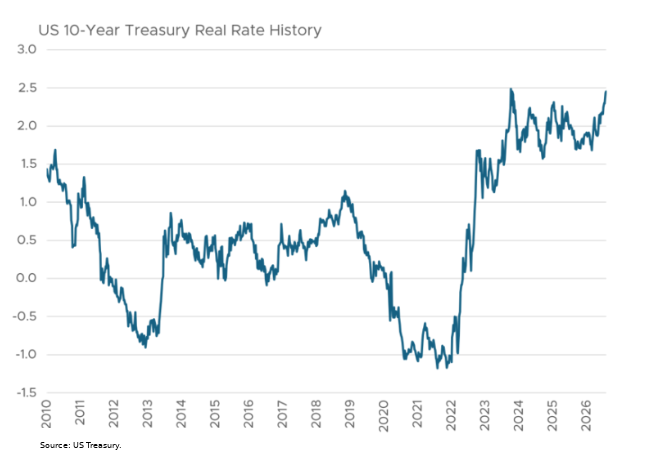
The chart shows how dramatically real yields have changed since the negative-rate environment of 2020–2022. That reset is a major reason TIPS deserve renewed attention.
The Number to Watch Is Breakeven Inflation
The second important number is breakeven inflation—the difference between the yield on a nominal Treasury and the real yield on a TIPS security of similar maturity. On August 7, the nominal 10-year Treasury yielded 4.65%, while the 10-year TIPS real yield was 2.40%. The difference was 2.25%, which is the approximate 10-year breakeven inflation rate.
4.65% nominal Treasury yield ≈ 2.40% real yield + 2.25% breakeven inflation
If inflation averages above roughly 2.25% over the coming decade, TIPS would generally have the relative advantage over a comparable nominal Treasury. If inflation averages below that level, nominal Treasuries would generally have the advantage.
Today’s 3.5% CPI reading does not prove that TIPS are mispriced. CPI measures inflation that has already occurred, while the breakeven reflects what the market is pricing over the years ahead.
Inflation Protection Does Not Eliminate Bond Risk
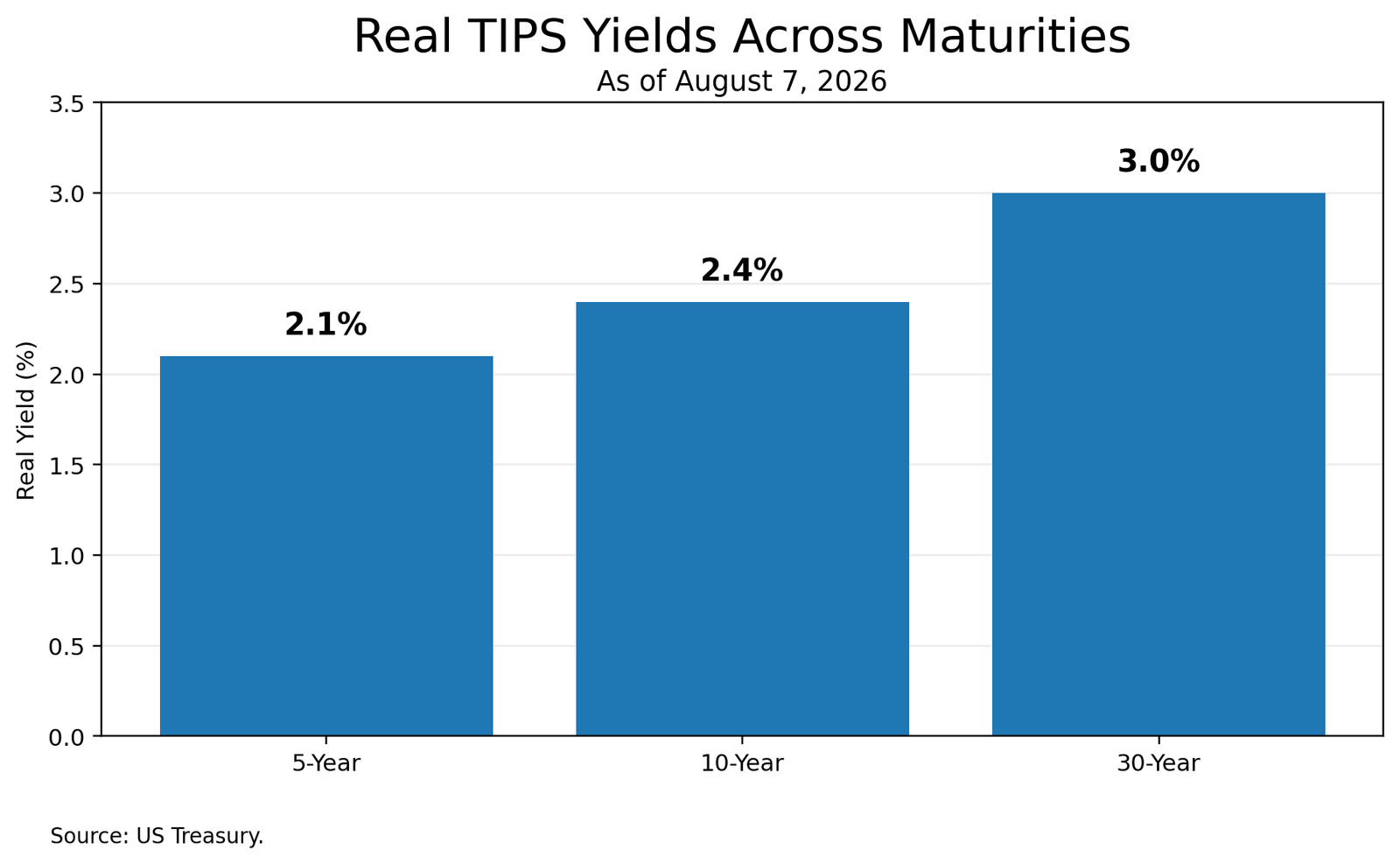
The word “protected” can create a false sense of security. TIPS protect against unexpected inflation, but they do not protect investors from changes in real interest rates. Current real yields rise from roughly 2.1% on five-year TIPS to 2.4% at 10 years and nearly 3.0% at 30 years. The extra yield can look tempting, but longer maturities generally come with greater sensitivity to rate changes.
Real TIPS Yields Across Maturities
See How the Pieces of Your Retirement Plan Work Together
Investments are only one part of retirement planning. Our complimentary Your GPS to Holistic Retirement Planning course explains how income planning, investments and taxes can be coordinated around your goals while preparing for the risks retirement may bring.
Start Your GPS to Holistic Retirement Planning Course →
For the broader planning framework behind those decisions, explore our complimentary Your GPS to Holistic Retirement Planning course.
Retire once. Stay retired.
Complimentary retirement course + workbook
Let’s build a stronger, smarter plan together.
Schedule your free consultation today.
This material is provided for educational purposes only and is not intended as personalized investment, tax, or legal advice. Investing involves risk, including possible loss of principal.
Important Disclosure:This content is for educational purposes only and should not be considered personalized investment, tax, legal, accounting, or medical advice. Advanced Wealth Management, LLC is a Florida Registered Investment Adviser. Advisory services are offered on a fee basis. Investing involves risk, including the possible loss of principal. Advanced Wealth Management, LLC does not provide medical advice, diagnosis, or treatment.References to diagnostic platforms are provided for educational context only and should not be interpreted as endorsements, medical recommendations, or substitutes for guidance from a qualified healthcare provider. Always consult your physician or qualified healthcare provider before making changes to your healthcare, testing, medication, supplement, nutrition, or exercise routine. Please consult qualified tax, legal, insurance, and medical professionals regarding your personal situation.
At AWM, Our Fiduciary Duty Principles™ Define Our Commitment
This commentary is for informational and educational purposes only and is not investment, tax, legal, or accounting advice. Any investment involves risk, including the possible loss of principal. Private and alternative investments may be illiquid, may involve higher fees, may use leverage, may have limited transparency, and may not be suitable for all investors. Liquidity features (including redemption/repurchase programs) are not guaranteed and may be limited, suspended, or modified. Distributions are not guaranteed and may be sourced from factors other than operating cash flow. Tax treatment is complex and investor-specific; consult your tax advisor. Any offering is made only through applicable offering documents and only to eligible investors where lawful.
How We Can Help You
At AWM, we provide personalized, comprehensive guidance for individuals and families. Our services offer peace of mind and confidence through every stage of your financial journey:
- Investment Management: Our globally diversified, tax-efficient portfolios are designed for resilience across market conditions.
- Proactive Tax Planning: We focus on tax-efficient strategies for both accumulation and distribution phases, helping you manage liabilities.
- Integrated Goals-Based Planning: Align all life goals into a unified financial plan to navigate transitions strategically.
Contact AWM today to schedule a confidential consultation and connect with an advisor who can help you achieve your financial goals. For assistance, reach out to us at Service@awmfl.com.
Thank you for your continued trust and engagement.
Tony Gomes, Author, MBA
CEO and Founder
Advanced Wealth Management