

If the daily news has felt like a nonstop “breaking alert” parade… you’re not alone. Headlines are designed to hijack attention, not build confidence.
For retirees (and anyone close to retirement), the goal is even clearer: protect your lifestyle, protect your purchasing power, and protect your peace of mind. That means zooming out and focusing on the big forces that can shape the next decade—without turning your retirement plan into a high-stress guessing game.
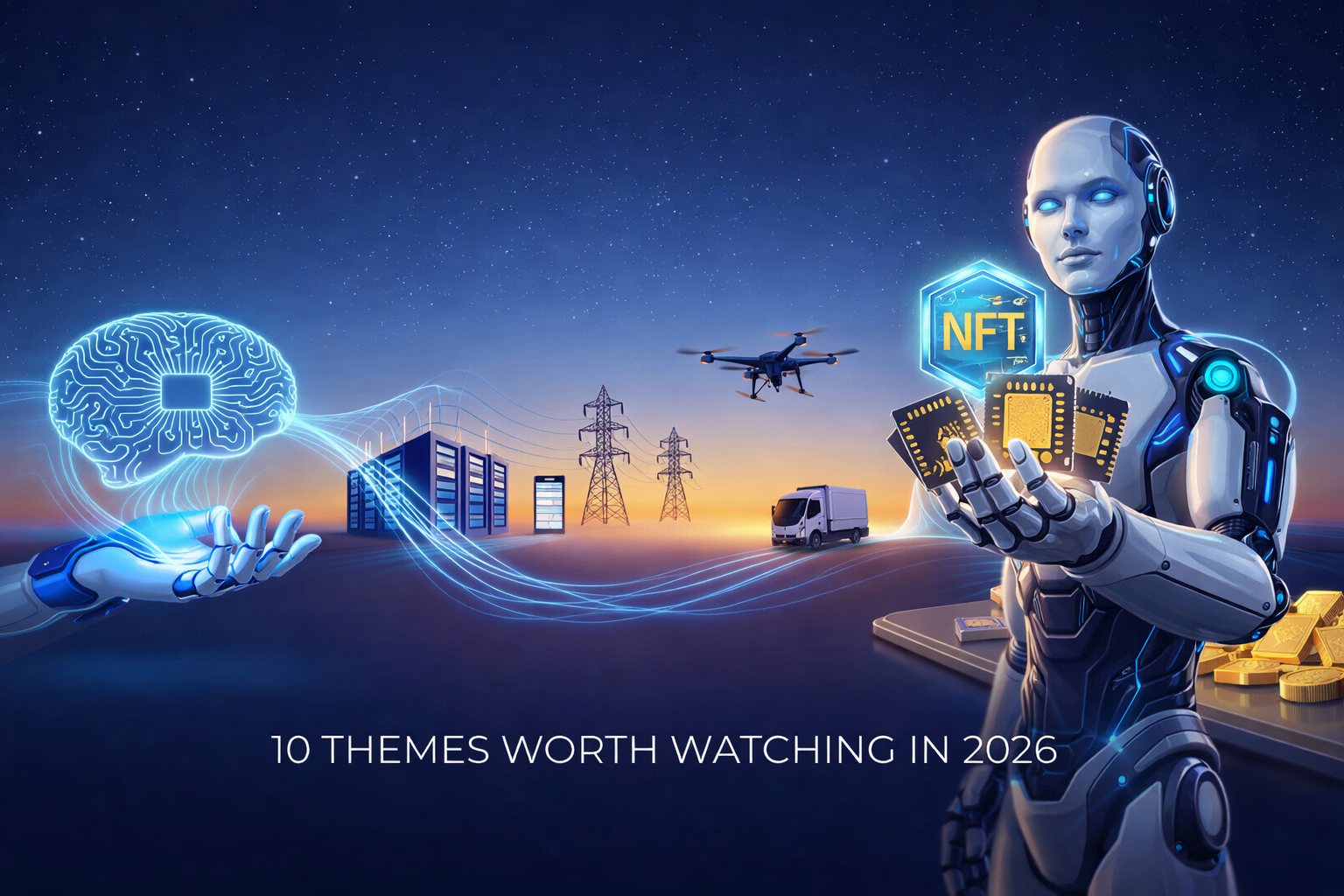
Below are 10 themes worth watching in 2026. Some are classic innovation stories. Others are “real world” crosscurrents—like gold and Bitcoin—that investors often consider when uncertainty rises. The point isn’t to chase everything. The point is to understand what’s changing, so you can stay grounded and intentional.
Why this matters more in retirement
When you’re retired, investing isn’t a scoreboard—it’s a support system. You’re not just trying to grow wealth; you’re trying to fund real life: housing, healthcare, travel, giving, helping family, and enjoying time.
That’s why retirees tend to value:
- Consistency over excitement
- A plan over predictions
- Flexibility over perfect timing
These themes are “watch items,” not marching orders. Your plan can stay calm while your awareness stays sharp.
1) AI becomes a utility: powerful intelligence gets cheaper and more available
The biggest shift isn’t that AI exists—it’s that it’s becoming dramatically cheaper and easier to use. When a powerful capability drops in cost, it usually expands into everything: work, services, education, healthcare, and daily life.
That’s how productivity waves typically happen: not in a straight line, but in bursts—then suddenly it feels like it’s everywhere.
What retirees may notice first:
- Faster, more helpful customer service (less time on hold)
- Better tools for planning, organizing, and researching big decisions
- More personalized health guidance and better detection tools over time
The opportunity isn’t just “AI companies.” It’s the businesses that use AI to deliver better outcomes at lower cost.
2) AI agents: from “answers” to “actions”
We’re moving from “AI answers questions” to “AI handles workflows.” That’s a meaningful leap.
AI agents can do multi-step tasks: schedule appointments, compare options, track paperwork, manage subscriptions, organize travel, and handle routine administrative chores. As agents improve, the winners won’t only be the model builders—the winners will be the companies that rebuild user experiences around this new interface.
Why retirees should care:
- Less friction managing life tasks (especially healthcare logistics)
- Less cognitive load for repetitive decisions
- More time and energy freed up for family and enjoyment
A simple way to think about it: agents aren’t just “smart.” They’re designed to be useful—and usefulness scales fast.
3) Compute and data centers: the quiet megaproject of the decade
AI has a physical footprint: data centers, GPUs, networking, cooling systems, and power. This buildout is becoming one of the most important “picks and shovels” stories of the decade.
And it creates ripple effects:
- More demand for electricity
- More investment in power grids
- More urgency for energy storage and reliability
Why retirees should care:
- Infrastructure booms can influence local development and utilities
- Reliability matters—especially if you spend more time at home
- Some of the “boring” behind-the-scenes trends are often the most durable
This theme is a reminder: the tech future isn’t just software. It’s steel, concrete, wiring, and power.
4) Robotics: from impressive demos to everyday deployment
Robots have been “almost ready” for years. The difference now is convergence—better sensors, better AI, and better economics. That combination moves robotics from “cool demo” to “useful worker.”
Adoption won’t flip overnight. It usually happens in stages:
- Robots take the least controversial tasks first (dangerous, repetitive, low-skill)
- They prove reliability
- Then they expand into more environments
Why retirees should care:
- Robotics can help reduce costs across goods and services
- It can support strained labor areas like elder care assistance and hospital logistics
- It can improve safety and consistency in many industries
Over time, robotics is less about sci-fi and more about “quiet improvement” everywhere.
5) Robotaxis and autonomy: mobility economics get rewritten
Autonomy isn’t just a tech story—it’s a utilization story. If vehicles can operate more hours per day, the economics of car ownership, fleets, and ride services can change dramatically.
Rollout will vary by city, regulation, and safety standards—but the trendline is clear: autonomy keeps moving from experimentation toward scale.
Why retirees should care:
- Mobility is independence
- Safer transportation options can be a quality-of-life upgrade
- It may expand “freedom of movement” for retirees who prefer not to drive at night, in bad weather, or at all
Even if you never use a robotaxi, the downstream impacts—insurance, maintenance, mapping, sensors—can reshape industries.
6) Autonomous logistics: drones, last-mile delivery, and trucking
Separate from passenger transport, logistics is undergoing its own transformation. Routes are structured. Repetition is high. Labor constraints are real. Those conditions tend to invite automation.
Expect ongoing experimentation:
- Drones for specific delivery use cases
- Automation and autonomy in trucking routes
- Smarter warehouse systems that cut delays and improve reliability
Why retirees should care:
- More convenience and access, especially in suburban or rural areas
- Potential improvements in pharmacy delivery and home essentials
- Less friction for caregivers coordinating supplies and equipment
Logistics innovation often shows up as “lower friction” and “faster delivery” long before it shows up in economic statistics.
7) Energy storage and grid modernization: the “unsexy” theme with big impact
Every exponential technology eventually runs into one constraint: energy. Reliability, capacity, and transmission all matter.
Energy storage, grid software, and grid buildout aren’t flashy dinner conversation topics—but they’re increasingly central to keeping growth engines running. If the world electrifies more things and powers more compute, the grid must level up.
Why retirees should care:
- Power reliability directly affects comfort, safety, and home life
- Utility costs and infrastructure upgrades can influence budgets
- A modern grid supports resilience during heat waves, storms, and peak demand
This isn’t just an investing theme. It’s a “stability of modern life” theme.
8) Firm power and nuclear: the baseload conversation returns
AI infrastructure doesn’t just need power—it needs reliable, steady power. That brings firm generation back into focus, including nuclear, as well as other dependable baseload solutions.
Regardless of personal opinions, one reality is rising: energy demand is becoming less negotiable, and reliability is more important than ideology.
Why retirees should care:
- Reliability reduces disruption (especially at home)
- Long-term energy planning affects costs and policy decisions
- Stable baseload power supports the broader economy that retirement portfolios depend on
In periods of growing demand, “all of the above” solutions often gain traction.
9) Multiomics plus AI: healthcare becomes an information business
One of the most hopeful themes is healthcare shifting from reactive to predictive.
Multiomics (genomics and related fields) combined with AI can support earlier detection, better targeting, and more personalized care. Timelines will vary and regulation matters—but the direction is powerful: better data + better models can mean better outcomes.
Why retirees should care:
- Earlier detection can mean more options and less invasive interventions
- Personalization can reduce trial-and-error treatment cycles
- Better health management supports the real goal: more healthy years
For retirees, this theme isn’t just financial—it’s personal. More quality years is the ultimate compounding.
10) The scarcity trade: gold and Bitcoin as long-term “insurance ideas”
When the world feels uncertain, people often gravitate toward scarcity.
Gold has a long history as a “durability” asset across eras. Bitcoin is digital scarcity with a fixed supply design and a completely different volatility profile. They’re not the same asset—but many investors think about them for a similar reason: long-term purchasing power protection.
Here’s the retiree-friendly way to think about it:
- These are not “get rich quick” tools
- They’re best viewed as potential diversifiers for some investors
- They require respect for volatility and thoughtful sizing
And as you requested: If you’ve ever thought about holding gold or Bitcoin long term, this can be a smart time to begin picking some up gradually—slowly, intentionally, and in a way that doesn’t disrupt your core retirement plan. The goal isn’t to time the perfect day. The goal is to build a measured position that you can hold through ups and downs.
The part that matters most: staying positive without being reckless
Here’s the sane middle path—especially for retirees.
1) Keep your core plan boring on purpose
In retirement, your portfolio has a job: fund your life. That job is easier when the foundation is designed for durability, not excitement.
Why this benefits retirees:
- It helps reduce “sell at the wrong time” risk when markets get shaky
- It supports steadier withdrawals and spending decisions
- It protects your ability to say yes to life—travel, family, generosity—without constantly recalculating
A simple mindset shift that helps:
Your core plan isn’t there to impress anyone. It’s there to keep your life stable.
2) Use high-volatility themes as satellites, not foundations
Innovation themes, concentrated bets, and scarcity assets can have a place—but they shouldn’t be the floor your retirement stands on.
Why this benefits retirees:
- You can participate in upside without putting your lifestyle at risk
- Volatility stays emotionally manageable (which reduces panic decisions)
- You preserve flexibility for healthcare needs and unexpected expenses
If you want exposure to volatile areas, retirees often do best when it’s sized small enough that a big drawdown doesn’t change the way they live.
And again, for gold and Bitcoin specifically: if you’ve ever considered holding either long term, beginning gradually can help you avoid the pressure of trying to “get the timing perfect.”
3) Focus on process, not predictions
Forecasts are fragile. Discipline is durable. Retirees don’t need perfect predictions—they need repeatable decisions that reduce regret.
Why this benefits retirees:
- It prevents costly timing mistakes driven by fear or excitement
- It creates consistency in withdrawals and rebalancing
- It builds confidence because the plan doesn’t depend on guessing next month correctly
A retiree-friendly process can be simple:
- Review your plan on a schedule (not every headline)
- Rebalance with rules, not feelings
- Make major moves only after a “cooling-off” period
4) Treat news like sugar
A little is fine. Constant intake is not.
Why this benefits retirees:
- Less stress and decision fatigue
- Fewer impulsive changes that lock in losses
- More attention for the things that actually improve outcomes (spending choices, taxes, healthcare planning, estate goals, and allocation discipline)
One of the most underrated retirement strategies is protecting your attention. It’s hard to build wealth—or enjoy it—when your nervous system is constantly being poked by breaking alerts.
Want to learn how investors access opportunities before the IPO? View my Private Market Alpha Guide
Many of the most important wealth-creation stories begin in the private markets—years before the average investor ever sees them.
My Private Market Alpha Guide is designed to educate you on how private investing works and why private markets can matter—especially as tomorrow’s category leaders grow before they ever go public. This includes companies that people often discuss in the private market conversation, like SpaceX, Starlink, OpenAI, Anduril, and others that may become the next multi-billion-dollar names.
Here’s the question worth thinking about:
Would you rather have owned Google, Microsoft, Amazon, Apple, etc. when they were private… or after they went public?
That’s the potential advantage of understanding private markets: learning where growth can happen earlier in a company’s lifecycle—before the “IPO moment” becomes a headline.
Call to action: View the Private Market Alpha Guide for more information and education.
Quick reality check (especially for retirees): private investments can involve long lockups, limited liquidity, complex structures, and the possibility of total loss. Education first. Fit second. Sizing last.
Let’s build a stronger, smarter plan together.
Schedule your free consultation today
At AWM, Our Fiduciary Duty Principles™ Define Our Commitment
Our Fiduciary Duty Principles™ reflect our dedication to transparency, ensuring that your goals remain our priority. Knowledge equips you with the tools to make strategic decisions and optimize financial outcomes.
How We Can Help You
At AWM, we provide personalized, comprehensive guidance for individuals and families. Our services offer peace of mind and confidence through every stage of your financial journey:
- Investment Management: Our globally diversified, tax-efficient portfolios are designed for resilience across market conditions.
- Proactive Tax Planning: We focus on tax-efficient strategies for both accumulation and distribution phases, helping you manage liabilities.
- Integrated Goals-Based Planning: Align all life goals into a unified financial plan to navigate transitions strategically.
Contact AWM today to schedule a confidential consultation and connect with an advisor who can help you achieve your financial goals. For assistance, reach out to us at Service@awmfl.com.
Thank you for your continued trust and engagement.
Tony Gomes, Author, MBA
CEO and Founder
Advanced Wealth Management
Content Disclosure: The information here is general and educational. It is not a substitute for professional advice and does not constitute a recommendation. Forecasts and opinions are subject to change.