

When the Headlines Get Louder, the Plan Matters More

Dear Clients and Friends,
I’m updating this note because the market tone changed meaningfully from yesterday.
As I write this, the market is no longer acting like this is just another weekend headline that investors can shrug off by Monday afternoon. By late morning Tuesday, the Dow, S&P 500, and Nasdaq were each down a bit more than 2%, the S&P 500 had fallen to its lowest level in more than two months, and the VIX had climbed to a fresh three-month high. That doesn’t mean investors should panic. It does mean the market is sending a clearer message today than it did yesterday: this has become an energy, inflation, and confidence story — not just a geopolitical headline.
The biggest driver is oil. By late morning, Brent crude was up about 7.8% to $83.81 a barrel and U.S. crude was up 8.4% to $77.23, with both benchmarks pushing to their highest levels in many months. U.S. gasoline futures were up nearly 5% and diesel futures were up nearly 14%. And this is not just a fear trade based on imagination. Reuters reported that the widening conflict has disrupted shipping and energy infrastructure across the region: tankers and container ships have been avoiding the Strait of Hormuz after insurers canceled coverage, and shutdowns or disruptions were reported in places including Qatar, Israel, Saudi Arabia, and Iraq. Roughly one-fifth of the world’s oil consumption moves through that waterway, which is why markets are reacting so quickly.
That is why I think today’s market action deserves more respect than Monday’s bounce.Yesterday, the market still had a bit of a “buy the dip and move on” attitude. Today looks different. This morning, Reuters described a broader global selloff, with Europe and Asia also under pressure, while markets waited for possible U.S. action to offset the hit to consumers from higher energy prices.
What really caught my attention, though, was not just stocks or oil. It was the bond market.In a classic fear event, I would normally expect Treasury yields to fall as investors rush for safety. Instead, yields moved higher. Reuters reported the U.S. 10-year yield rose as much as nearly 5 basis points to about 4.10% before trimming some of that move, and markets pushed expectations for the next Fed rate cut back to September from July.
That is a very different signal than a plain-vanilla “flight to safety.”
To me, that says the market is increasingly worried that higher energy costs could feed inflation again just as investors had been hoping inflation pressure would continue easing. Reuters also reported the dollar strengthening against the euro, sterling, and yen as traders reassessed the path of rate cuts. Even precious metals slipped under the weight of the stronger dollar.
In other words, this is starting to look less like a temporary scare and more like the kind of shock that can complicate the inflation outlook.That does not mean I think investors should start tearing apart long-term plans. It does mean I think we should be honest about what the market is telling us: the risk here is not just “bad news overseas.” The real transmission mechanism is energy, inflation, rates, and confidence.
That is why I always try to look through the noise and focus on the things that actually matter for portfolios:
- Is this likely to impair long-term cash-flow plans?
- Does it change the inflation assumptions we need to use?
- Does it alter liquidity needs?
- Does it require a wholesale shift in strategy, or simply more discipline?
Most of the time, the answer is not “blow everything up.”
Most of the time, the answer is “go back to the plan.”
What history says about market shocks
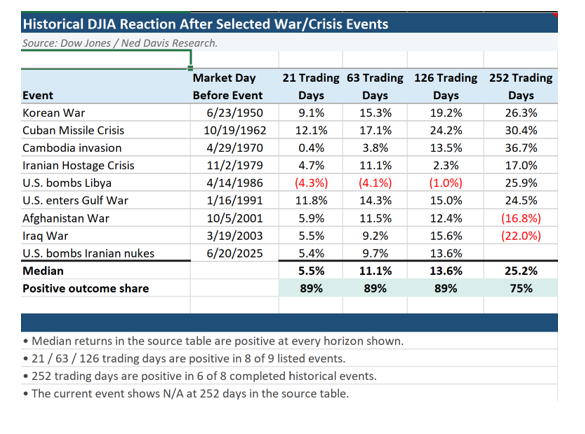
One reason I’m staying grounded is that markets have seen geopolitical crises before.Not once. Not twice. Repeatedly.No two events are the same, and I’m always careful not to oversimplify history. But history can still teach the right lesson: markets often recover faster than emotions do.That is exactly why I like the first chart in this post. It looks at the median stock-market response after a set of major geopolitical and war-related shock events. And while it’s not a forecast, the pattern is still worth remembering: in many past cases, the market reaction after the initial shock was better than investors feared.That is not a promise. It is not a guarantee. It is simply a reminder that selling into fear has usually been a very expensive emotional decision.
Markets have lived through worse headlines than this
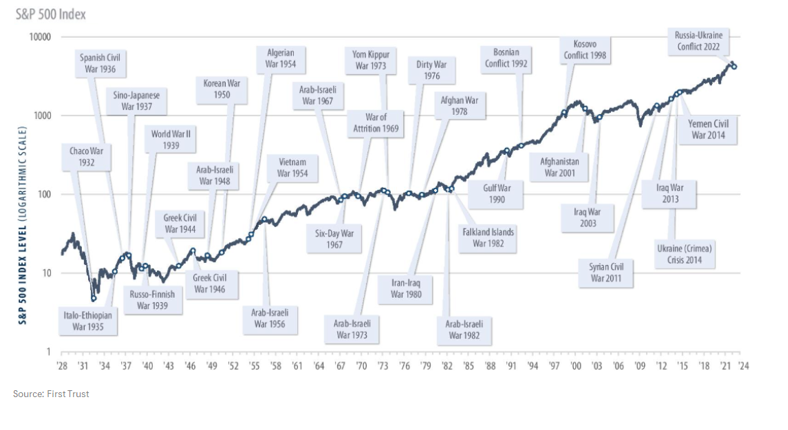
The second chart is the wider-angle lens, and I think it may be the more important one. It shows the S&P 500 across decades of wars, invasions, civil conflicts, geopolitical shocks, and global uncertainty. The point of that chart is not to trivialize conflict or pretend every event is harmless. The point is to show that long-term market returns have historically been driven more by earnings, productivity, innovation, and human adaptability than by any single headline.
Markets have lived through wars, terror attacks, oil shocks, inflation waves, recessions, banking crises, and political disorder. And yet, over time, the market has still shown an upward bias.That is why I keep reminding clients that the market is a terrible place to look for emotional comfort — but a pretty good place to study resilience.
What I’m watching right now
At this point, I’m focused on four things.
- First, I’m watching oil more than I’m watching the talking heads:If oil stabilizes, the market can begin to regain its footing. If oil keeps climbing and stays elevated, this becomes more than a scare — it becomes an inflation and growth problem.
- Second, I’m watching rates:If bond yields keep rising alongside weaker stocks, that is not the usual “defensive” market behavior. That is the market saying inflation risk may be overtaking recession fear, at least for now.
- Third, I’m watching whether policymakers try to cushion consumers:Reuters reported that markets were awaiting a U.S. government announcement on steps that could offset the impact on consumers, potentially including a Strategic Petroleum Reserve release or some form of domestic support.
- Fourth, I’m watching the Fed tone:New York Fed President John Williams said further rate cuts are still possible if inflation follows the path he expects, but Kansas City Fed President Jeffrey Schmid said inflation remains too hot and there is no room for complacency. Markets have already pushed expected easing deeper into the year.
That tells me the macro backdrop just got trickier.
What I’m doing for clients
I am not responding to this by getting dramatic,I am responding the same way I always do when the noise level goes up: by getting more disciplined. I’m reviewing portfolios through the lens of income needs, liquidity needs, inflation sensitivity, and behavioral risk.
I’m asking the questions that actually matter:
- What cash flow is needed in the next 12 months?
- What is already covered?
- What needs to stay liquid?
- Where are we taking compensated risk versus uncompensated risk?
- Are we still aligned with the purpose of the plan?
That is real portfolio management.
- Not reacting to every headline.
- Not pretending risk doesn’t exist.
- And definitely not confusing motion with progress.
I’m also reminding clients of something important: diversification is not exciting when one part of the market is ripping higher. But diversification is exactly what we build for moments like this. Broadly diversified portfolios across asset classes and geographies are designed for periods of uncertainty — not despite them, but because of them.
If this week reminded you that you want a better framework, start here
This is exactly why I built educational tools and not just portfolios.
If this week’s market action reminded you that you want a cleaner framework for retirement, income, taxes, liquidity, and risk, start with my Retirement Playbook. My planning page currently includes the free course/workbook, Your GPS to Holistic Retirement Planning, along with guides for Private Market Alpha, Social Security Quick-Start, Estate Planning Simplified, and The Complete Mega Backdoor Roth.
I built those resources to help people make better decisions before markets get emotional — not after. So if you’re feeling the pressure of this week’s headlines, do not let that pressure make the decision for you.
- Slow down.
- Look at the plan.
- Review the structure.
- Make sure your liquidity is where it should be.
- Make sure your income plan still works.
- Then decide what, if anything, actually needs to change.
That is how serious investors behave in serious markets.
My bottom line
Here is my honest read as of midday Tuesday:
The market is more unsettled today than it was yesterday. Oil is the main reason. Stocks are under pressure. Bond yields are up, not down. Rate-cut expectations have moved out. The dollar is stronger. Volatility is higher. That is the market’s way of saying this conflict matters because of what it may do to energy prices and inflation. But even with all of that, I do not believe this is a moment for fear-driven portfolio decisions.I believe it is a moment for perspective.History says markets have absorbed geopolitical shocks before. Good planning says diversification and liquidity exist for exactly these moments. And experience says the people who usually get hurt most are the ones who let an emotional day override a sound process.
So my message remains the same:
Look through the noise. Go back to the plan. Stay diversified. Stay disciplined.
And if you want help pressure-testing your plan against a market like this, start with the educational resources and then book a call.
That is why I’m here.
— Tony Gomes